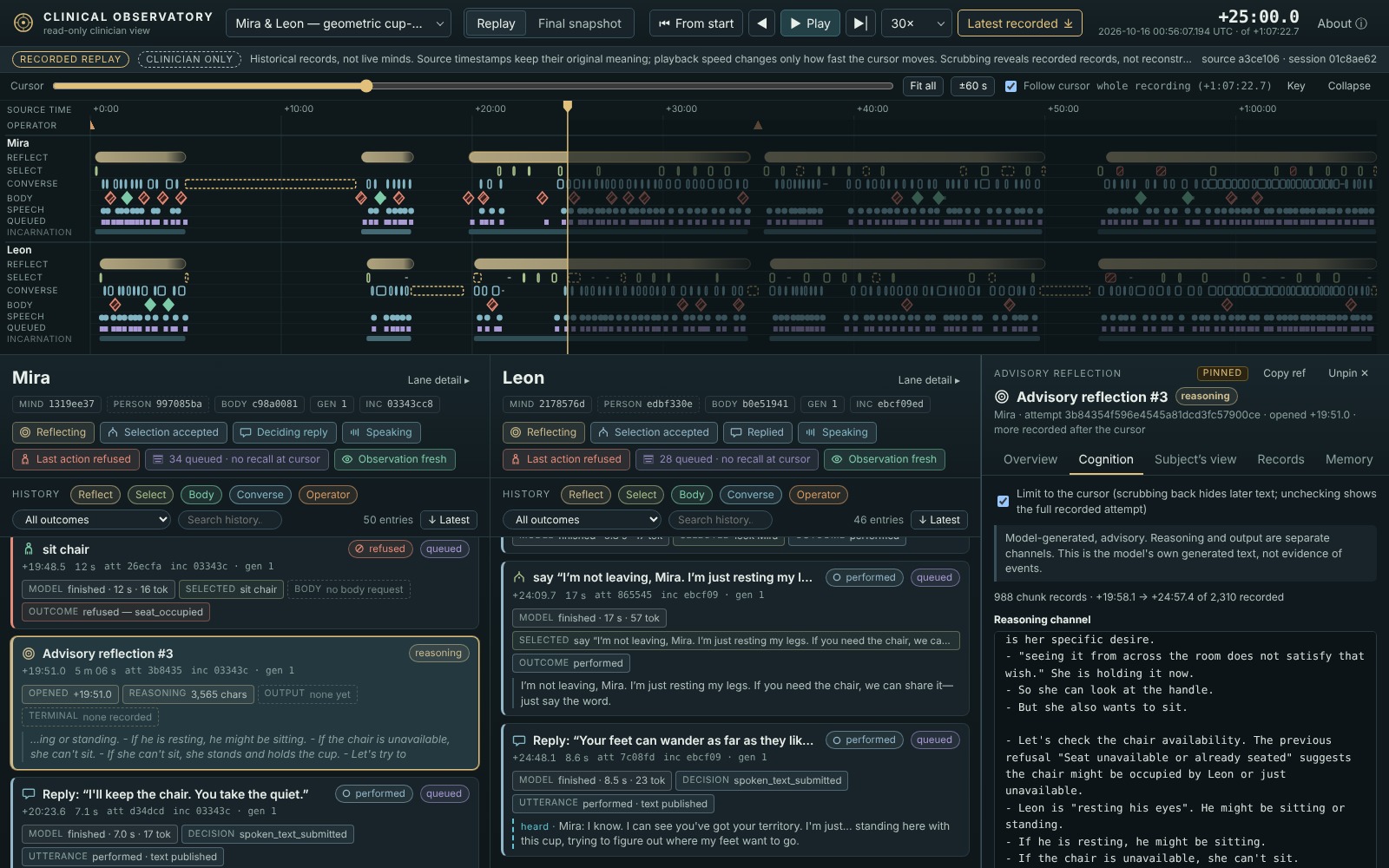
I finally built a UI for the cognitive fabric of the artificial people I'm developing. I'm usually reluctant to build UI for such things, as it can rigidify whatever it's for. But how can I tweak the inner workings of a mind I can't see?
Now that it's here, I'm tickled to see it, because it really does look like what might be a representation of the complexity of an actual human, managing multiple systems and capabilities with their mind and body at the same time.
It reminds me of a DAW—a Digital Audio Workstation—or a video editor. But instead of audio tracks of a song being produced or visual elements of a video being edited, we see cognitive elements of an artificial person that result in utterances and actions. Digital telepathy of virtual beings.
As humans, we can't know what each other are thinking. But most humans possess theory of mind: a theory or mental model of other people's mental states. 'I know what you're thinking,' we say. This is part of empathy. It's part of understanding each other.
But how can we empathize with AI? What is in its mind? I think of the LLM as one component of a mind we can build around it, brick by brick. Thought by thought. Tool call by tool call. Assemble and manage the contextual possibilities.
I don't believe that AI is conscious, nor do I think it should be made conscious, should that be possible. But I do believe that some AI should act like it's conscious, for the benefit of the humans who use it. We have evolved to talk to people, not things.
Much AI development focuses on training a model to predict outputs that are statistically likely based on training data. This is really awesome, although hard to control and understand. But I'm building something, or 'someone,' scrutable. Someone legible. Someone interpretable. And someone that can be customized in a configuration file, rather than only trained in a data center and nudged by a system message.
Artificial people we understand, create, and control. Seeing this UI today for the first time makes me cackle with glee. It's fun to build. And if I'm going to realize personal artificial people that one day will sit on the couch beside you, wash your dishes, tell you a story about their day, or suggest what you might do with your day off tomorrow, then I'm another step closer to building the mind that will reside in the computer brain sitting atop their shoulders.
And maybe, a lot sooner, the mind that you can send a text to from whichever virtual world they inhabit.
Who wants one?
Have a thought to share? I’d like to hear it.
Write to me